
Stairs & landings · Daly City
Stair and Landing Installation in Daly City
Treads, risers, nosings, and landings fitted on site across the two-level homes of Daly City, Broadmoor, and San Bruno.
(650) 414-5793 — quote my staircaseStairs Are Where People Judge a Floor Job
Stair and landing installation in Daly City is the part of the work that gets inspected closest, because a staircase puts every joint, miter, and return at eye level instead of underfoot. Half the housing stock in this city is two levels, a lot of it the Doelger-era design with the living space above and the garage below, which means almost every whole-house flooring project here involves a flight of stairs and at least one landing. Flooring Installation Daly City cuts stair material on site rather than ordering pre-finished pieces and hoping the rise and run match, because in houses of this age no two treads are exactly the same depth. The other thing that matters on stairs is fastening. A tread that moves is a tread that squeaks, and a nosing that was only glued will separate from the riser within a couple of years of daily traffic.
What Stair Installation Includes
Stairs are priced per step rather than per square foot, so the estimate is easy to compare against anyone else.
Measurement of every tread and riser individually
Older staircases drift, so each step gets measured on its own rather than cutting a stack of identical pieces from one dimension. This is why our stairs sit tight against both stringers.
Removal of existing carpet, treads, or covering
The old surface, pad, tack strip, and staples come off each step and the bare tread is inspected for rot, splits, and movement.
Substrate repair and squeak correction
Loose treads are screwed and glued back to the stringers, shims are driven where there are gaps, and any split or soft tread is replaced before new material goes on.
Solid wood tread installation
Full-thickness hardwood treads are cut to length, scribed to the stringers or skirtboard, and set in construction adhesive with concealed fasteners so the face stays clean.
Retread caps over existing stairs
Where the existing treads are sound, a thinner retread cap is bonded over them, which is faster and cheaper than full replacement and gives the same finished appearance.
Riser installation and finishing
Risers are cut, fitted, and finished to match or contrast the tread, with the joint at the back of the tread kept tight so the whole flight reads as one assembly.
Stair nosing to match plank or laminate floors
Where a vinyl plank or laminate floor continues onto the stairs, matching manufactured nosing is used at each step edge so the profile and color carry through.
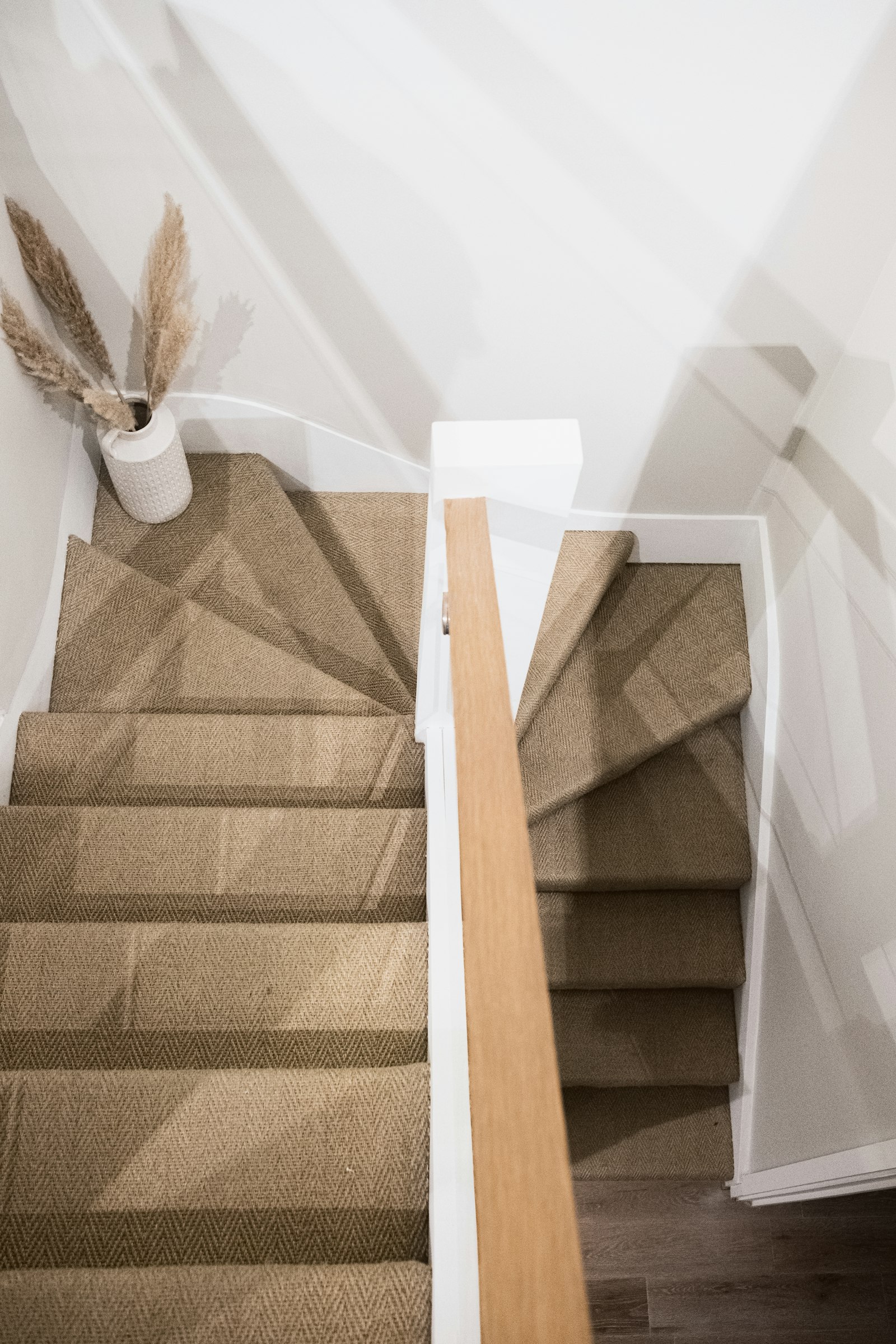
Carpet on stairs, wrapped or capped
Waterfall or upholstered installation depending on the look you want, with each tread stretched and fastened individually rather than one continuous loose run.
Landing installation
Landings are laid out so the material direction relates correctly to both the flight below and the floor above, with the perimeter and nosing detailed to match the treads.
Skirtboard and stringer trim
Where a skirtboard exists it is scribed and reinstalled; where the stringer is open, the tread returns are mitered so the end grain is never exposed.
Handrail and baluster protection
Existing rails and balusters are masked and protected during the work and any fasteners disturbed at the base of a newel are re-secured.
Final inspection on every step
We walk the flight with you checking for movement, gaps at the stringer, and consistency in nosing overhang from the bottom step to the top.
How a Staircase Job Runs
- 01
Measure the flight and pick an approach
We measure each tread, check the condition of what is underneath, and talk through whether full treads, retread caps, or carpet is the right answer for the staircase and the budget. Stairs price per step rather than per square foot, so the estimate is straightforward and easy to compare.
- 02
Strip, repair, and prepare
The old covering comes off, the treads and stringers get inspected, and anything loose or damaged is fixed. This is the stage where existing squeaks get eliminated permanently, and it usually takes a few hours for a standard flight.
- 03
Install, finish, and cure
Treads, risers, nosings, and landings go in from the top down or bottom up depending on access. Adhesive needs to cure before heavy use, so most flights are finished in a day and ready for normal traffic the following morning. We stage the work so you always have a way up and down.
Why Hire Us for Stairs
Every step is measured on its own
In houses built to the same plan sixty years ago, the treads have still moved differently. Cutting to a single dimension leaves visible gaps at the stringer, so we cut to what is actually there.
Fastened and glued, not glued alone
Adhesive on its own fails eventually under daily impact. We use concealed mechanical fasteners along with adhesive, which is why our stairs do not develop the hollow click that appears on retread jobs a couple of years in.
The stairs match the floor because the same crew does both
Nosings, stain, and transition detail are chosen alongside the field material and installed by the same people, so the staircase does not look like it was added afterward by someone else.
On every staircase
- CSLB Licensed, Bonded & Insured
- Priced Per Step, Not Estimated
- Cut and Fitted On Site
- Squeaks Corrected Before Installation
- Free In-Home Measurement
- Written Workmanship Warranty
Have Your Staircase Quoted Per Step
Stairs are usually quoted last and rushed first, which is why so many flights in this city have gaps at the stringer and a squeak on the fourth step. We will measure every tread, tell you whether full replacement or a retread cap makes sense, and give you a number per step you can actually compare. Most standard flights are a single day of work.
(650) 414-5793